
Press Release
Arxia, The Next Major Layer 1, Records First Blockchain Transaction Over LoRa Radio Without Internet, Cellular, or Satellite

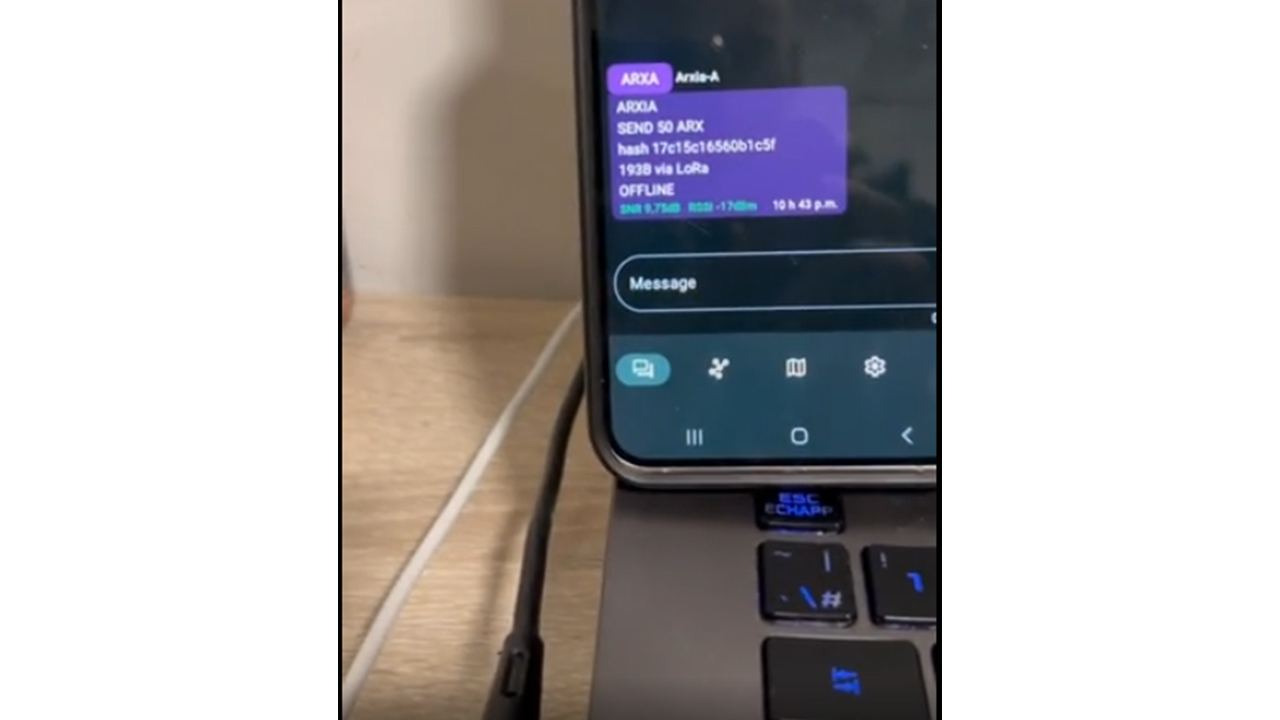
A signed 193-byte Layer 1 transaction transmitted between two ESP32 nodes on the 868 MHz unlicensed band and validated locally, with no infrastructure of any kind.
May 1, 2026. Arxia, an offline-first Layer 1 blockchain built in Rust, today recorded its first end-to-end transaction transmitted exclusively over LoRa radio between two physical hardware nodes. The transaction was signed locally on a TTGO T-Beam (ESP32 paired with an SX1276 radio module), broadcast on the 868 MHz unlicensed band, received by a second T-Beam, and relayed to a paired Android phone over Bluetooth Low Energy. At no point did the transaction traverse the internet, a cellular network, or a satellite link.
The transmitted block was 193 bytes, the compact binary format Arxia engineered to fit inside the 256-byte LoRa MTU. The receiving node verified the Ed25519 signature, validated the nonce against its local registry, and updated its ledger. The sender wallet persisted to a new balance of 951 ARX at nonce 2.
Footage of the transmission, including serial port logs, packet metadata, and on-device wallet state, is published on the official channels listed below.
What This Actually Means
Decentralization has been the core promise of crypto since 2008. In practice, every existing Layer 1 has shipped that promise on top of the same fragile infrastructure as the banks it was built to replace. When the internet goes down, Bitcoin goes down. Ethereum goes down. Solana goes down. Every stablecoin, every DeFi position, every hardware wallet becomes a string of useless characters on a screen until a server somewhere decides to come back online. The 580 million people who hold crypto today are not insulated from a network outage. They are entirely exposed to it.
Arxia removes that dependency at the protocol layer. A transaction that runs over LoRa radio, signed with Ed25519 and validated by a block lattice ledger, does not care whether your ISP is operating, whether your government has flipped the kill switch, or whether the submarine cables in the Red Sea are still intact. The receiver gets the value. The sender’s balance updates. The ledger reconciles when the partitions reconnect.
“It is absurd that the entire industry talks about decentralization while building everything on top of an internet connection,” said Kwon Jihak, lead contributor on the Arxia codebase. “As if it has never occurred to anyone that a government would cut that connection the second it serves them. We just made that scenario stop mattering.”
A Layer 1, Not a Messaging Wrapper
Several open source projects, including Meshtastic, Briar, and Bridgefy, already allow signed messages over LoRa or Bluetooth without an internet connection. None of them are blockchains. A signed message over radio is not a currency. Without a shared ledger, two recipients in two isolated network partitions can each receive the same unit of value from the same sender, with both signatures cryptographically valid. There is no double-spend prevention, no global state, no node incentive structure, and no path to sovereign identity.
Arxia is a full Layer 1 protocol. Each account maintains its own block lattice chain. Transactions are reconciled across network partitions through Conflict-free Replicated Data Types (CRDTs). Consensus is established via Open Representative Voting (ORV) adapted for offline mesh networks. A four-tier finality model gives recipients explicit guarantees at every connectivity level, from BLE-only (L0) to global ledger confirmation (L2).
Bitcoin’s Blockstream Satellite service is also frequently cited as proof that blockchains already work without internet. It does not. Blockstream Satellite is receive-only. The user must broadcast their transaction over the internet for the network to confirm it. The satellite link merely echoes blocks back. Arxia transactions are created, signed, transmitted, validated, and reconciled bidirectionally over radio.
Built for Adversarial Conditions
A blockchain that operates offline must answer the harder version of every classical question. How do you stop someone from spending the same coin twice in two isolated network partitions? How do you order conflicting transactions without synchronized timestamps? How does a recipient know whether a transaction will hold once the network reconnects?
Every Arxia transaction carries a unique incremental nonce signed by the sender’s private key. The same nonce cannot be reused. When two partitions rejoin with conflicting transactions on the same nonce, ORV consensus picks the winner deterministically: the partition with greater stake weight prevails, with vector clocks and lexicographic hash ordering as tie-breakers. The losing transaction is rolled back.
The receiver address is embedded inside the signed payload, which means a captured transaction cannot be replayed to a different wallet. Relay nodes sign cryptographic receipts for every transaction they forward, so no node can claim rewards for traffic it never relayed. The four-tier finality model gives recipients explicit guarantees per connectivity level: L0 transactions over Bluetooth alone are capped at 10 ARX with a visible warning, L1 transactions confirmed through synchronized LoRa nodes are capped at roughly 50 USD equivalent, and L2 reaches absolute finality once 67 percent of validators confirm.
The codebase is open source and has been under public adversarial review since the repository went live, with all critical findings patched and verifiable in the commit history.
Technical Footprint
– 193-byte compact block format, 73 percent smaller than the equivalent JSON serialization
– Ed25519 signatures, Blake3 hashing, ChaCha20-Poly1305 encryption primitives
– Block lattice consensus with per-account chains and ORV stake-weighted voting
– 34 of 34 protocol tests passing on x86_64, including 10 gossip protocol scenarios across linear, single-bridge, and broken-bridge topologies
– Cross-compiled to ESP32 (Xtensa LX6, ESP-IDF v5.3.2)
– Open source under MIT and Apache 2.0 licenses
About Arxia
Arxia is a Layer 1 blockchain designed from first principles to operate over fragmented and intermittent networks. The architecture combines block lattice consensus, CRDT reconciliation, W3C Decentralized Identifiers, and a multi-modal transport stack spanning LoRa radio, Bluetooth Low Energy, SMS, and DVB-S2 satellite. The codebase is fully open source. A 2.4 million USDC seed round is currently open under a SAFT structure (6-month cliff, 24-month linear vesting via Sablier V2 on Base).
– Repository: github.com/ArxiaLayer1/Arxia
– Website: arxia.one
– X / Twitter: @ArxiaLayerOne
– Telegram: t.me/ArxiaLayeronePortal
Press Contact


Prosecutors Say Jason Finkelstein Spent 11 Seconds Reviewing Cardiac Images Before Clearing a Teenage Athlete

Prosecutors Say Jason Finkelstein Spent 11 Seconds Reviewing Cardiac Images Before Clearing a Teenage Athlete
Prosecutors Say Jason Finkelstein Spent 11 Seconds Reviewing Cardiac Images Before Clearing a Teenage Athlete
Prosecutors Say Jason Finkelstein Spent 11 Seconds Reviewing Cardiac Images Before Clearing a Teenage Athlete

Prosecutors Say Jason Finkelstein Spent 11 Seconds Reviewing Cardiac Images Before Clearing a Teenage Athlete
Prosecutors Say Jason Finkelstein Spent 11 Seconds Reviewing Cardiac Images Before Clearing a Teenage Athlete

Prosecutors Say Jason Finkelstein Spent 11 Seconds Reviewing Cardiac Images Before Clearing a Teenage Athlete
Prosecutors Say Jason Finkelstein Spent 11 Seconds Reviewing Cardiac Images Before Clearing a Teenage Athlete
Prosecutors Say Jason Finkelstein Spent 11 Seconds Reviewing Cardiac Images Before Clearing a Teenage Athlete

Prosecutors Say Jason Finkelstein Spent 11 Seconds Reviewing Cardiac Images Before Clearing a Teenage Athlete
Prosecutors Say Jason Finkelstein Spent 11 Seconds Reviewing Cardiac Images Before Clearing a Teenage Athlete
Prosecutors Say Jason Finkelstein Spent 11 Seconds Reviewing Cardiac Images Before Clearing a Teenage Athlete
Prosecutors Say Jason Finkelstein Spent 11 Seconds Reviewing Cardiac Images Before Clearing a Teenage Athlete

Prosecutors Say Jason Finkelstein Spent 11 Seconds Reviewing Cardiac Images Before Clearing a Teenage Athlete
Prosecutors Say Jason Finkelstein Spent 11 Seconds Reviewing Cardiac Images Before Clearing a Teenage Athlete

-
Alternative Energy5 days ago
Brian Rowan’s Possible Defense: No Intent, No Control, No Fraud, Just Sales
-
Alternative Energy5 days ago
Federal Grand Jury Indicts Oren Shachar in Hospice Fraud Case
-
Business4 days ago
How Darrell Seale Builds High-Performing Teams Through Service-Based Leadership
-
Education4 days ago
Daniel Cullen Delafield on Bridging Executive Leadership and Skilled Trades Development
-

 News2 days ago
Prosecutors Say Jason Finkelstein Spent 11 Seconds Reviewing Cardiac Images Before Clearing a Teenage Athlete
-
News2 days ago
Prosecutors Say Jason Finkelstein Spent 11 Seconds Reviewing Cardiac Images Before Clearing a Teenage Athlete
-
News2 days ago
Prosecutors Say Jason Finkelstein Spent 11 Seconds Reviewing Cardiac Images Before Clearing a Teenage Athlete
-
News2 days ago
Prosecutors Say Jason Finkelstein Spent 11 Seconds Reviewing Cardiac Images Before Clearing a Teenage Athlete